
The study of cellular biology stands as the cornerstone of modern science, serving as the gateway to understanding how life originates, sustains, and reproduces. In the CBSE Class 9 curriculum, the chapter “Cell: The Building Block of Life” introduces students to the microscopic world, shifting their perspective from macroscopic organisms to the intricate molecular factories operating within them. For the academic session 2026-2027, the Central Board of Secondary Education (CBSE) has placed an unprecedented emphasis on competency-based learning, experimental analysis, and critical thinking, making a thorough grasp of this chapter absolutely vital for scoring perfect marks.
This comprehensive guide is meticulously designed to serve as the ultimate resource for Class 9 students aiming for academic excellence. By aligning directly with the latest NCERT textbook guidelines, this article provides flawless, step-by-step solutions to every in-text and back-exercise question. As an elite CBSE Board Exam Grader, I have integrated exclusive “Topper’s Tips” and high-scoring keywords that examiners actively look for when evaluating answer sheets, ensuring that your answers stand out.
Beyond the standard textbook exercises, this guide features an exhaustive repository of extra practice questions, including high-order thinking skills (HOTS) questions, long-form conceptual explanations, and extract-based analytical passages. Whether you are trying to master the complex pathways of membrane biogenesis, differentiate between mitotic and meiotic cell divisions, or understand the biophysics of osmosis, this guide simplifies complex concepts into highly structured, easily digestible portions. Let us embark on this fascinating journey into the microscopic unit of life.
Understanding the Cell as the Basic Unit of Life
The concept of the cell as the fundamental unit of life is one of the most revolutionary discoveries in scientific history. It began in 1665 when Robert Hooke, using a primitive self-designed microscope, observed thin slices of cork and noticed tiny, box-like compartments resembling the rooms of a monastery, which he termed “cells.” Over the centuries, technological advancements—transitioning from simple lenses to sophisticated light microscopes and high-resolution electron microscopes—have allowed scientists to peer deep into the nanometer scale, revealing that these tiny compartments are actually highly dynamic, living systems.
The classical Cell Theory, formulated by Matthias Schleiden (1838), Theodor Schwann (1839), and Rudolf Virchow (1855), provides the unifying framework for all biological sciences. This theory asserts that all living organisms, from unicellular bacteria to multicellular humans, are composed of cells; the cell is the structural and functional unit of life; and all cells arise solely from pre-existing cells through division. This continuity of life explains how a single fertilized egg can divide repeatedly to form a complex organism containing trillions of specialized cells working in perfect harmony.
Within any living cell, there is an extraordinary division of labor. Eukaryotic cells contain specialized, membrane-bound structures called organelles, such as the nucleus, mitochondria, endoplasmic reticulum, and Golgi apparatus, each performing distinct chemical activities. This compartmentalization prevents different cellular reactions from interfering with one another, allowing the cell to synthesize proteins, generate energy, eliminate waste, and respond to environmental stimuli simultaneously, much like a highly automated, modern factory.
Complete Solutions for Class 9 In-Text Questions
In-text questions are strategically placed throughout the NCERT chapter to test a student’s immediate understanding of core concepts and experimental setups. These questions often bridge the gap between theoretical knowledge and practical application, focusing heavily on activities like potato osmometer experiments and microscopic observations of onion peels. For the 2026-2027 academic session, CBSE has increased the weightage of these application-based questions, making it essential to write precise, scientifically accurate answers.
When answering in-text questions, students must focus on explaining the “why” and “how” behind biological phenomena. For instance, when discussing osmosis, simply stating that water moves is insufficient; one must specify the role of the selectively permeable membrane and the concentration gradient. The following solutions have been drafted to meet these exact grading standards, utilizing precise scientific vocabulary while remaining highly accessible to Class 9 students.
Below are the complete, board-exam-quality solutions for every in-text question found within the pages of the Class 9 textbook. Each solution is structured with clear headings, bullet points, and bold keywords to maximize readability and scoring potential.
Part 1: In-Text (In-Between Chapter) Questions Solved
Question 1 (Pause and Ponder 1) [Page 14]: What argument would you give for the necessity of a cell wall in plants usually fixed in one place versus in animals usually moving from one place to the other?
Answer:
- Plants are stationary organisms and cannot move to seek shelter from harsh environmental conditions such as strong winds, heavy rain, high temperatures, and osmotic pressure variations. Therefore, they require a rigid, protective outer layer called the cell wall (made of cellulose) to provide mechanical strength, structural support, and protection against environmental stress.
- Animals, on the other hand, are mobile and can actively move to escape unfavorable weather, predators, or environmental hazards. Consequently, animal cells do not require a rigid cell wall; instead, they possess only a flexible cell membrane, which allows for the cellular elasticity and rapid movement necessary for animal tissues and locomotion.
Question 2 (Pause and Ponder 2) [Page 14]: What consequences would you predict for a plant cell if its cell wall were to become as flexible as a cell membrane?
Answer:
If the plant cell wall were to become as flexible as a cell membrane, the following consequences would occur:
- Loss of Structural Support: The plant would lose its rigidity and mechanical strength, causing leaves, stems, and flowers to wilt and collapse under their own weight.
- Vulnerability to Osmotic Lysis (Bursting): In a hypotonic environment (like heavy rain), water would continuously enter the plant cell via endosmosis. Without a rigid cell wall to exert turgor pressure (counter-pressure) against the entering water, the flexible cell would swell and eventually burst.
- Inability to Withstand Environmental Stress: The plant would become highly susceptible to physical damage from wind, rain, and gravity.
Question 3 (Pause and Ponder 3) [Page 14]: Why is it important to cut the two potato pieces in roughly equal size and measure their initial weight before placing them in different liquids?
Answer:
- Standardization of Variables: Cutting the potato pieces to roughly equal sizes ensures that the surface area available for osmosis is kept constant, making the experiment a fair test.
- Establishing a Baseline: Measuring the initial weight is crucial because osmosis is quantified by the change in weight (final weight minus initial weight). Without knowing the starting mass, it is impossible to determine whether the potato piece has gained water (swelled) or lost water (shrunk), or to calculate the exact percentage change in mass.
Question 4 (Pause and Ponder 4) [Page 20]: Do white flowers contain any pigment? Give reasons.
Answer:
- No, white flowers generally do not contain colored pigments like anthocyanins (which give red, purple, or blue colors) or carotenoids (which give yellow or orange colors).
- The white appearance of flower petals is primarily due to the presence of microscopic air spaces between the cells. When sunlight hits these air-filled spaces, it is completely reflected back in all wavelengths, making the petals appear white to our eyes.
- However, white flowers may contain colorless plastids called leucoplasts or colorless flavonoids that absorb ultraviolet (UV) light, which helps attract insect pollinators like bees that can see UV light.
Question 5 (Pause and Ponder 5) [Page 20]: Draw a well-labelled schematic diagram of a plant or an animal cell using these clues:
(i) Nucleus appears as a dark and round body inside the cell.
(ii) ER spreads like a network of extended nuclear envelope.
(iii) Mitochondria and chloroplasts are rod shaped.
Answer:
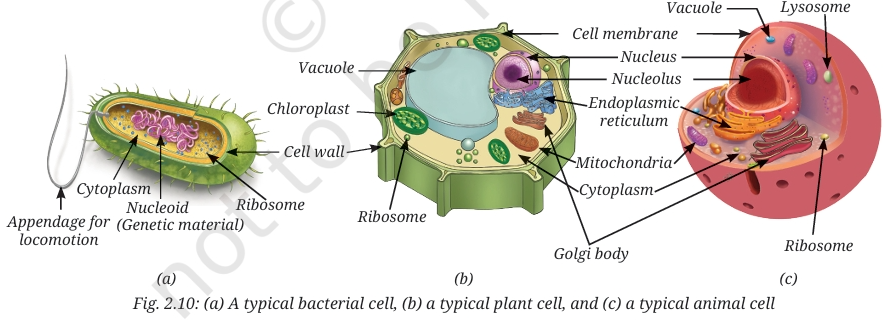
Question 6 (Pause and Ponder 6) [Page 22]: Instead of many small ones, why does a cell not have a single giant mitochondrion? How does this relate to the concept of surface area?
Answer:
- Surface Area-to-Volume Ratio: A single giant mitochondrion would have a much smaller total surface area compared to the combined surface area of many small mitochondria. Having numerous small mitochondria dramatically increases the total surface area of the inner mitochondrial membrane (cristae) relative to the volume.
- Efficiency of Energy Production: The chemical reactions of cellular respiration (ATP synthesis) occur on the inner membrane. A larger surface area provides more space for ATP-generating enzymes, maximizing energy production.
- Localized Energy Distribution: Multiple small mitochondria can easily move and distribute themselves to different regions of the cell where energy demand is highest. A single giant mitochondrion would struggle to supply energy efficiently to distant parts of a large eukaryotic cell.
Question 7 (Pause and Ponder 7) [Page 22]: If the skin cells start dividing by meiosis instead of mitosis, what do you think will happen to a cut on the skin?
Answer:
If skin cells divided by meiosis instead of mitosis, the healing of a cut would fail due to the following reasons:
- Reduction in Chromosome Number: Meiosis produces haploid cells (containing half the original number of chromosomes). The newly formed skin cells would lack a complete set of genetic instructions, leading to cellular malfunction and death.
- Genetic Variation: Meiosis introduces genetic variations through crossing over. The new cells would not be genetically identical to the surrounding skin cells, preventing the formation of uniform, functional skin tissue.
- Insufficient Cell Production: Mitosis produces two identical cells directly to replace damaged tissue, whereas meiosis is a complex, two-step process meant for producing gametes. Meiotic division would fail to rapidly regenerate the protective epithelial barrier, leaving the cut open and highly vulnerable to infections.
NCERT Back Exercise Questions with Topper Tips
The “Revise, Reflect, Refine” section at the end of the NCERT chapter contains comprehensive questions designed to evaluate a student’s overall mastery of cellular biology. These questions range from direct structural comparisons to complex experimental analyses. To secure a perfect score in these exercises, students must present their answers systematically, using tables for comparisons and highlighting key scientific terms.
As an experienced board examiner, I often observe students losing marks not because they lack knowledge, but because their answers lack structure. For instance, when asked to differentiate between cell structures, writing long paragraphs instead of a clear, tabular format is a common mistake. Additionally, omitting key terms like “selectively permeable,” “concentration gradient,” or “membrane biogenesis” can prevent you from getting full marks.
To help you excel, this section provides complete, textbook-accurate solutions for all back-exercise questions. Underneath every complex or long-form question, you will find a dedicated Topper’s Tip box. These tips reveal the exact keywords, structural formats, and conceptual points that examiners look for when awarding full marks.
Part 2: Official NCERT Textbook Back-Exercises Solved
Question 1 [Page 24]: Differentiate between the following pairs of terms based on the clues given in parentheses:
(i) Cell membrane and cell wall (permeability)
(ii) RER and SER (structure)
(iii) Chloroplasts and chromoplasts (pigments)
Answer:
| Feature | (i) Cell Membrane | (i) Cell Wall |
|---|---|---|
| Permeability | It is selectively permeable, allowing only specific substances to pass through while blocking others. | It is fully permeable, allowing water and dissolved minerals to pass through freely. |
| Feature | (ii) Rough Endoplasmic Reticulum (RER) | (ii) Smooth Endoplasmic Reticulum (SER) |
|---|---|---|
| Structure | It has a rough surface due to the attachment of ribosomes on its outer membrane. | It has a smooth surface because it lacks ribosomes on its membrane. |
| Feature | (iii) Chloroplasts | (iii) Chromoplasts |
|---|---|---|
| Pigments | They contain the green pigment called chlorophyll (essential for photosynthesis). | They contain non-green pigments like yellow, orange, or red carotenoids. |
Topper’s Tip: Always present differences in a neat tabular format as shown above. Underline key terms like “selectively permeable”, “ribosomes”, and “chlorophyll” to draw the examiner’s eye directly to the correct scientific terms.
Question 2 [Page 24-25]: Two similar animal cells are placed in two different solutions:
- Cell X is placed in pure water.
- Cell Y is placed in a concentrated salt solution.
Cells are observed after some time. Cell X swells, and Cell Y shrinks. Which statement provides the correct explanation for the above observations?
(i) Salt molecules moved into Cell Y, causing it to shrink.
(ii) Water moved into Cell X and more water moved out of Cell Y than the salt solution entered in it.
(iii) Water moved into Cell X and moved out of Cell Y through the cell membrane.
(iv) Solute movement caused osmosis in both cells.
Answer:
The correct statement is (iii) Water moved into Cell X and moved out of Cell Y through the cell membrane.
Explanation:
- Cell X is in pure water (a hypotonic solution), where the water concentration outside is higher than inside the cell. Water moves into the cell via endosmosis, causing it to swell.
- Cell Y is in a concentrated salt solution (a hypertonic solution), where the water concentration outside is lower than inside the cell. Water moves out of the cell via exosmosis, causing it to shrink. Osmosis involves only the movement of solvent (water) molecules, not solute (salt) molecules.
Question 3 [Page 25]: Look at the diagram of a cell in Fig. 2.20. Identify the parts labelled from (a) to (g) and correctly match them with their functions given below:
(i) Controlling all the activities of a cell.
(ii) Site of cellular respiration.
(iii) Storage organelle that also provides rigidity to the cell.
(iv) Separates the cell contents from surroundings.
(v) Provides structural rigidity to the cell.
(vi) Packs and stores materials received from ER.
(vii) Helps in manufacturing food.
Answer:
Based on the plant cell diagram (Fig. 2.20), the identification and matching are as follows:
- (a) Cell Wall matches with (v) Provides structural rigidity to the cell.
- (b) Cell Membrane matches with (iv) Separates the cell contents from surroundings.
- (c) Chloroplast matches with (vii) Helps in manufacturing food.
- (d) Nucleus matches with (i) Controlling all the activities of a cell.
- (e) Mitochondrion matches with (ii) Site of cellular respiration.
- (f) Vacuole matches with (iii) Storage organelle that also provides rigidity to the cell.
- (g) Golgi apparatus matches with (vi) Packs and stores materials received from ER.
Topper’s Tip: In matching questions, write the label letter, the name of the organelle, and its function clearly. This structured presentation prevents any confusion and guarantees full marks.
Question 4 [Page 25]: Which of the following option(s) of the pairs of cell organelles are correctly placed under the given categories?
(Note: Based on the textbook’s context of organelle classification, we categorize them by their membrane structure)
| Category | Organelle Pair | Correct / Incorrect |
|---|---|---|
| Double Membrane-bound | Mitochondria and Chloroplasts | Correct |
| Single Membrane-bound | Lysosomes and Endoplasmic Reticulum | Correct |
| Non-membrane bound | Ribosomes and Centrosomes | Correct |
Question 5 [Page 25]: Two students, Renu and Rohit, were having a discussion on the plastids. Renu emphasised that all parts of the plants, even roots, contain plastids. However, Rohit did not agree with the statement and told her that plastids are absent in plant roots since the roots are underground and do not need to perform photosynthesis. Who is correct? Justify your answer.
Answer:
Renu is correct.
Justification:
- Plastids are not limited to green, photosynthetic parts of a plant. They exist in various forms depending on the tissue and its function.
- While underground roots lack chloroplasts (since they are not exposed to sunlight and do not perform photosynthesis), they do contain another type of plastid called leucoplasts.
- Leucoplasts are colorless plastids specialized for storing food materials. For example, the root cells of plants like sweet potato and taro contain leucoplasts that store starch, proteins, and lipids. Therefore, plastids are indeed present in plant roots.
Topper’s Tip: To score full marks here, clearly state who is correct in the very first sentence. Then, use the scientific term “leucoplasts” and explain their storage function as your justification.
Question 6 [Page 25]: Mitochondria and chloroplasts are two important organelles in a plant cell. Discuss how these two organelles are structurally and functionally similar to each other, and different from each other.
Answer:
Structural and Functional Similarities:
- Double Membrane: Both organelles are bounded by a double-membrane system (outer and inner membranes).
- Semiautonomous Nature: Both possess their own DNA and 70S ribosomes, allowing them to synthesize some of their own proteins and replicate independently within the cell.
- Energy Transformation: Both are involved in energy conversion processes (chloroplasts convert light energy into chemical energy; mitochondria convert chemical energy into ATP).
Structural and Functional Differences:
| Feature | Mitochondria | Chloroplasts |
|---|---|---|
| Occurrence | Found in almost all eukaryotic plant and animal cells. | Found only in green plant cells and some algae. |
| Inner Structure | Inner membrane is folded into finger-like projections called cristae. | Inner space contains a fluid called stroma and stacked disc-like structures called thylakoids. |
| Pigments | Completely lack photosynthetic pigments. | Contain the green pigment chlorophyll and carotenoids. |
| Primary Function | Perform cellular respiration to break down glucose and generate ATP (energy currency). | Perform photosynthesis to synthesize glucose using sunlight, carbon dioxide, and water. |
Question 7 [Page 25]: Which of the following pairs of cell organelles contains DNA?
(i) Chloroplasts, Ribosomes
(ii) Mitochondria, Nucleus
(iii) Golgi bodies, Ribosomes
(iv) Nucleus, Lysosomes
Answer:
The correct option is (ii) Mitochondria, Nucleus.
Reason: The nucleus contains the primary genomic DNA of the cell. Mitochondria (and chloroplasts) are semiautonomous organelles that contain their own extranuclear circular DNA. Ribosomes and lysosomes do not contain DNA.
Question 8 [Page 25-26]: A researcher carried out an experiment in which she took two carrots of similar size. She placed one carrot in plain water and the other carrot in concentrated salt solution (Fig. 2.21). After 24 hours she recorded her observations.
(i) What hypothesis does she want to test through this experiment?
(ii) What would you suggest for the improvement of this experiment?
(iii) Why does the carrot in plain water stay stiff and crunchy, but the carrot in concentrated salt solution become rubbery and limp?
Answer:
- (i) Hypothesis to be tested: The researcher wants to test the hypothesis of osmosis—specifically, how water moves across a selectively permeable cell membrane in response to different external solute concentrations (hypotonic vs. hypertonic environments).
- (ii) Suggestions for improvement:
- Measure and record the initial and final weight of both carrots using a weighing balance to obtain quantitative data.
- Measure the initial and final volume/length of the carrots.
- Use multiple carrots in each setup to calculate an average, reducing experimental error.
- (iii) Scientific Explanation:
- Carrot in Plain Water (Beaker A): Plain water is a hypotonic solution relative to the carrot cells. Water enters the carrot cells via endosmosis, making the cells highly turgid (swollen and firm). This makes the carrot stay stiff and crunchy.
- Carrot in Salt Solution (Beaker B): The concentrated salt solution is a hypertonic solution. Water moves out of the carrot cells into the beaker via exosmosis, causing the cells to lose turgor pressure and undergo plasmolysis (shrinkage of cell contents). This makes the carrot rubbery and limp.
Topper’s Tip: Use the terms “endosmosis”, “exosmosis”, “turgid”, and “plasmolysis” in sub-question (iii). These are the exact technical terms that board graders look for.
Question 9 [Page 26]: Indicate the presence or absence of following structures in bacterial and animal cells:
Answer:
| Structures in a Cell | Bacterial Cell | Animal Cell |
|---|---|---|
| Chromosome | Present (Single, circular, without histones) | Present (Multiple, linear, with histone proteins) |
| Nucleus | Absent (Has an undefined nucleoid region) | Present (Well-defined with nuclear membrane) |
| Mitochondria | Absent | Present |
| Golgi complex | Absent | Present |
| Chromoplasts | Absent | Absent |
Question 10 [Page 26]: Carry out the following experiment:
Take four peeled potato halves and scoop each one out to make potato cups. One of these potato cups should be made from a boiled potato. Place each of the potato cups in a beaker containing water (Fig. 2.22). Now, set up the experiment as follows:
(a) Keep Cup A empty.
(b) Add one teaspoon sugar in Cup B.
(c) Add one teaspoon salt in Cup C.
(d) Add one teaspoon sugar in the boiled potato in Cup D.
Observe the four potato cups at least two hours and answer the following questions:
(i) Explain why water gathers in the hollowed portion of Cup B and Cup C.
(ii) Why is Cup A necessary for this experiment?
(iii) Explain why water does not gather in the hollowed portions of Cups A and D.
Answer:
- (i) Why water gathers in Cup B and Cup C: The addition of sugar (Cup B) and salt (Cup C) inside the hollowed cavity creates a highly concentrated (hypertonic) environment compared to the water in the beaker. Since the potato cells are alive, their cell membranes act as a selectively permeable membrane. Water moves from the beaker (hypotonic) through the potato cells into the cavity via osmosis, accumulating as liquid.
- (ii) Why Cup A is necessary: Cup A is a control experiment. It shows that in the absence of a solute (concentration gradient), water does not move on its own. It proves that the accumulation of water in Cups B and C is specifically due to the concentration gradient created by sugar and salt.
- (iii) Why water does not gather in Cups A and D:
- In Cup A: There is no solute inside the cavity, meaning there is no concentration gradient to drive osmosis.
- In Cup D: Boiling the potato denatures the proteins and kills the cells, completely destroying the selectively permeable nature of the cell membranes. Since a living, selectively permeable membrane is a prerequisite for osmosis, no water can move into the cavity of the boiled potato cup.
Question 11 [Page 26]: Identify the pair that incorrectly matches the cell organelle with its function.
(i) Ribosome — Protein synthesis
(ii) SER — Lipid and cellulose synthesis
(iii) Lysosome — Digestion of foreign agents
Answer:
The incorrect match is (ii) SER — Lipid and cellulose synthesis.
Reason: While the Smooth Endoplasmic Reticulum (SER) is indeed responsible for lipid and steroid hormone synthesis, it is not involved in cellulose synthesis. Cellulose is a complex carbohydrate synthesized at the plasma membrane level by specific enzyme complexes (cellulose synthase) to form the cell wall.
Question 12 [Page 26]: What outcome do you expect, if all the mitochondria are removed from a eukaryotic cell?
Answer:
If all mitochondria are removed from a eukaryotic cell, the following outcomes are expected:
- Cessation of Aerobic Respiration: The cell will no longer be able to perform aerobic cellular respiration, which is the most efficient pathway for breaking down glucose.
- Severe Energy Crisis: The production of ATP (Adenosine Triphosphate), the energy currency of the cell, will drop drastically. The cell will have to rely solely on anaerobic glycolysis in the cytoplasm, which yields a mere 2 ATP molecules per glucose molecule compared to the 36-38 ATP produced with mitochondria.
- Failure of Vital Functions & Cell Death: Active transport, protein synthesis, cell division, and metabolic pathways will grind to a halt due to the lack of energy, leading to rapid cellular starvation and eventual cell death.
Question 13 [Page 26]: Which phenomenon inhibits the formation of tumors in the human body? Can plants also develop tumors? Explain.
Answer:
- Phenomenon inhibiting tumors in humans: Contact inhibition and Programmed Cell Death (PCD / Apoptosis). Contact inhibition is a process where normal animal cells stop dividing when they come into contact with neighboring cells, preventing overcrowding. Programmed Cell Death selectively eliminates damaged, mutated, or old cells before they can divide uncontrollably.
- Can plants develop tumors? Yes. Plants can also develop tumors (often called galls). A classic example is the Crown Gall disease caused by the soil bacterium Agrobacterium tumefaciens, which inserts its DNA into plant cells, forcing them to divide uncontrollably.
- Difference in plant tumors: Unlike animal tumors, plant tumors do not undergo metastasis (spreading to other parts of the body). This is because plant cells are locked in place by their rigid cell walls, which prevent mutated cells from breaking free and migrating through a circulatory system.
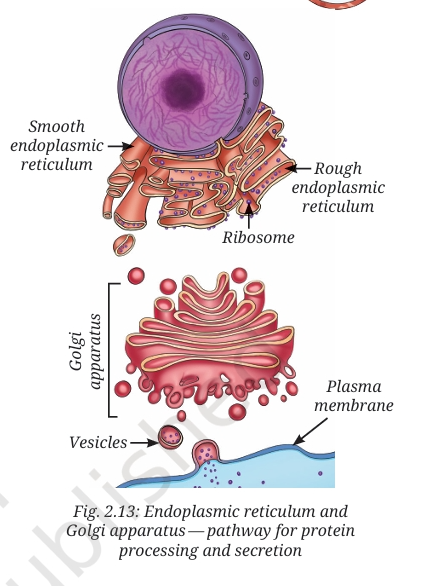
Question 14 [Page 27]: The cell membrane of a cell is made up of proteins and lipids. Which cell organelles help in the synthesis of cell membrane? Write the path of these compounds from their site of synthesis to the cell membrane and show this through a labelled diagram.
Answer:
- Organelles involved: The Rough Endoplasmic Reticulum (RER) synthesizes proteins (via attached ribosomes), and the Smooth Endoplasmic Reticulum (SER) synthesizes lipids. The Golgi apparatus modifies, packages, and dispatches these molecules.
- Path of the compounds (Membrane Biogenesis):
- Synthesis: Proteins are synthesized on the RER; lipids are synthesized on the SER.
- Transport to Golgi: These proteins and lipids are packed into transport vesicles that bud off from the ER and fuse with the cis-face of the Golgi apparatus.
- Modification & Packaging: In the Golgi cisternae, proteins and lipids are modified (e.g., converted into glycoproteins and glycolipids) and sorted.
- Final Delivery: The finished molecules are packed into secretory vesicles that bud off from the trans-face of the Golgi, move through the cytoplasm, and fuse with the existing cell membrane, integrating into its structure.
Question 15 [Page 27]: What would happen if gametes are formed by mitotic divisions?
Answer:
If gametes (sperm and egg cells) were formed by mitotic divisions instead of meiosis, the following consequences would occur:
- Doubling of Chromosome Number: Mitosis produces diploid (2n) daughter cells with the exact same number of chromosomes as the parent. If diploid gametes (2n) fused during fertilization, the resulting zygote would have a tetraploid (4n) number of chromosomes (double the normal amount).
- Genetic Instability Across Generations: With each successive generation, the chromosome number would continue to double exponentially (e.g., 2n -> 4n -> 8n -> 16n). This would disrupt the genetic blueprint of the species, leading to severe developmental defects, non-viable embryos, and the eventual extinction of the species.
- Loss of Genetic Diversity: Since mitosis does not involve crossing over or independent assortment, offspring would be genetic clones of a single parent line, eliminating the genetic variations essential for adaptation and evolution.
Question 16 [Page 27]: Based on the passage about Deepa preserving amla and lemons, answer the following questions:
(i) Which scientific concept has the farmer applied in the preservation of the farm produce?
(ii) How does the addition of high concentrations of salt and sugar create an environment that prevents the growth of spoilage-causing bacteria and fungi?
(iii) Suggest a healthy recipe of this kind for food preservation.
(iv) What are the scientific values addressed in this case?
Answer:
- (i) Scientific Concept Applied: The farmer has applied the concept of osmosis (specifically, exosmosis and plasmolysis) to dehydrate food and prevent microbial growth.
- (ii) Prevention of Microbial Growth: High concentrations of salt (in pickles) or sugar (in murabbas/sharbat) create a highly hypertonic environment outside any bacterial or fungal cells that land on the food. Water inside the microbial cells immediately moves out into the surrounding medium via exosmosis. This causes severe plasmolysis (shrinkage) of the microbial protoplasm, rendering the bacteria and fungi inactive or killing them, thereby preventing food spoilage.
- (iii) Healthy Recipe Suggestion: Sun-Dried Salted Amla Slices: Cut fresh amla into small pieces, toss them with a moderate amount of rock salt and turmeric (which has natural antimicrobial properties), and spread them on a clean cloth to dry in the sun for 3 to 4 days. The sun removes moisture, and the salt prevents microbial growth, creating a healthy, preservative-free snack with a long shelf life.
- (iv) Scientific Values Addressed:
- Resourcefulness and Innovation: Utilizing traditional scientific knowledge to solve modern post-harvest waste problems.
- Economic Sustainability: Transforming perishable agricultural waste into value-added commercial products to boost income.
- Environmental Consciousness: Reducing food waste and promoting sustainable food security.
Extra Practice Questions for CBSE 2026-2027
To secure a perfect score in the 2026-2027 CBSE Board Exams, students must prepare beyond the standard textbook exercises. The board has increasingly integrated competency-based, analytical, and high-order thinking skills (HOTS) questions into the science paper. These questions test a student’s ability to apply cellular concepts to novel scenarios, analyze experimental data, and understand the biophysical principles governing life.
This section provides a comprehensive bank of extra practice questions categorized into short-answer, long-answer, and extract-based formats. These questions cover critical, high-yield topics such as the fluid-mosaic model, the role of the cytoskeleton, the evolutionary history of mitochondria and plastids (endosymbiotic theory), and the mechanics of cell division.
By practicing these questions, students will develop the analytical skills required to tackle any unexpected question in the exam. Each question is accompanied by a detailed, high-scoring answer, and difficult concepts include a “Quick Memorization Trick” to help you retain complex information effortlessly.
Part 3: Extra Short Answer Questions (18 Questions)
Question 1: Who discovered the living cell for the first time, and how did it differ from Robert Hooke’s discovery?
Answer: Anton van Leeuwenhoek (1674) discovered the first free-living cell (bacteria and protozoa) in pond water using an improved microscope. Robert Hooke (1665) had only observed dead, empty cell walls of cork tissue.
Question 2: What is the limit of resolution of the human eye, and how is it defined?
Answer: The limit of resolution of the human eye is 0.1 mm (at a distance of 25 cm). It is the minimum distance by which two close points must be separated to be seen as distinct and separate entities rather than a single blurred point.
Question 3: Why is the cell membrane described as a “fluid-mosaic”?
Answer: It is “fluid” because its lipid and protein molecules can move sideways, rotate, and flip within the membrane. It is a “mosaic” because proteins are embedded in the lipid bilayer like tiles in a mosaic pattern.
Question 4: What are thermophiles, and where are they found in India?
Answer: Thermophiles are heat-loving, unicellular bacteria that thrive in extreme temperatures near the boiling point of water. In India, they are found in the hot springs of Puga Valley in Ladakh.
Question 5: What is the chemical composition of a plant cell wall?
Answer: The plant cell wall is primarily composed of cellulose, a complex carbohydrate made of linked glucose units that provides structural strength and acts as dietary roughage for humans.
Question 6: What is “nucleoid” and how does it differ from a nucleus?
Answer: A nucleoid is an undefined, non-membrane-bound region in the cytoplasm of prokaryotes containing a single circular DNA molecule. A nucleus is a double-membrane-bound organelle containing linear chromosomes found in eukaryotes.
Question 7: Why are ribosomes called the “protein factories” of the cell?
Answer: Ribosomes are the specific sites where amino acids are assembled into proteins based on genetic instructions. They can exist freely in the cytoplasm or attached to the RER.
Question 8: What is the function of the nucleolus?
Answer: The nucleolus is a dense, non-membrane-bound body inside the nucleus responsible for the synthesis of ribosomal RNA (rRNA) and the assembly of ribosomal subunits.
Question 9: Differentiate between diffusion and osmosis.
Answer: Diffusion is the net movement of particles from a higher to a lower concentration (occurs in solids, liquids, and gases without a membrane). Osmosis is specifically the diffusion of water molecules across a selectively permeable membrane.
Question 10: What are cell inclusions? Give examples.
Answer: Cell inclusions are non-living, non-metabolic substances stored in the cytoplasm of plant cells, such as starch granules, silica, or crystals of calcium oxalate.
Question 11: Why do mature human Red Blood Cells (RBCs) lack a nucleus?
Answer: The absence of a nucleus (enucleation) provides more internal space for hemoglobin, allowing the RBC to bind and transport a much larger volume of oxygen throughout the body.
Question 12: What is the lifespan of a human RBC, and why can it not repair itself?
Answer: The lifespan is approximately 120 days. Because RBCs lack a nucleus and ribosomes, they do not contain the genetic blueprint or machinery required to synthesize proteins for cellular repair or division.
Question 13: What are the three types of plastids and their primary functions?
Answer:
- Chloroplasts: Contain chlorophyll for photosynthesis.
- Chromoplasts: Contain yellow/red/orange pigments to color flowers and fruits.
- Leucoplasts: Colorless plastids that store starch, oils, or proteins.
Question 14: What is “totipotency”? Who proposed this concept?
Answer: Totipotency is the ability of a single, mature plant cell to divide and develop into an entire, fully functional plant when provided with suitable nutrients and conditions. It was proposed by Gottlieb Haberlandt in 1902.
Question 15: What is the role of the cytoskeleton?
Answer: The cytoskeleton is a network of fine protein fibers in eukaryotic cells that provides structural support, maintains cell shape, and facilitates internal transport and cell movement.
Question 16: Why are lysosomes called “suicide bags” of the cell?
Answer: Lysosomes contain powerful digestive enzymes. If a cell is severely damaged or undergoes metabolic disruption, the lysosome can burst, releasing these enzymes which then digest and destroy the cell’s own components.
Question 17: What is “Programmed Cell Death” (PCD), and why is it useful?
Answer: PCD (or apoptosis) is a genetically regulated process of selective cell destruction. It is essential for normal development (e.g., removing webbed tissue between embryonic digits to form fingers) and eliminating damaged cells.
Question 18: What is “contact inhibition”?
Answer: Contact inhibition is a natural regulatory mechanism where normal animal cells stop dividing once they come into physical contact with neighboring cells, preventing uncontrolled tissue growth.
Quick Memorization Tricks:
- To remember the Cell Theory scientists:
- Trick: Sleeping Scholar Visits.
- Schleiden (Plants, 1838) -> Schwann (Animals, 1839) -> Virchow (Pre-existing cells, 1855).
- To remember the types of Plastids:
- Trick: Colorful Cook Locker.
- Chromoplast (Color) -> Chloroplast (Cook/Photosynthesis) -> Leucoplast (Locker/Storage).
Part 4: Extra Long Answer Questions (10 Questions)
Question 1: Explain the Endosymbiotic Theory regarding the origin of mitochondria and plastids. Provide three structural evidences from the text that support this theory.
Answer:
The Endosymbiotic Theory suggests that mitochondria and plastids (chloroplasts) were once free-living prokaryotic organisms (bacteria) that were engulfed by ancestral eukaryotic cells billions of years ago. Instead of being digested, they formed a mutually beneficial symbiotic relationship, eventually evolving into permanent cell organelles.
The textbook provides strong structural evidence supporting this evolutionary history:
- Independent Genetic Material: Both mitochondria and plastids possess their own circular DNA, which is highly similar to bacterial DNA, rather than the linear DNA found in the eukaryotic nucleus.
- Own Protein Synthesis Machinery: They contain their own ribosomes (70S type, similar to bacteria), allowing them to synthesize some of their own proteins independently of the cell’s cytoplasmic ribosomes.
- Double Membrane Structure: Both organelles are bound by a double membrane. The inner membrane resembles the original prokaryotic membrane, while the outer membrane represents the vesicle membrane formed when the ancestral cell engulfed them.
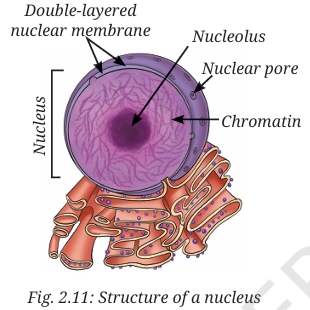
Question 2: Describe the structure of the nucleus with a neat, labeled diagram. Explain how chromatin material organizes into chromosomes during cell division.
Answer:
The nucleus is the control center of the eukaryotic cell. It consists of the following structural components:
- Nuclear Envelope: A double-layered membrane that encloses the nucleus. It contains numerous nuclear pores that regulate the transport of macromolecules (like RNA and proteins) between the nucleus and the cytoplasm.
- Nucleoplasm: The semi-fluid matrix inside the nucleus.
- Nucleolus: A dense, spherical body where ribosomal subunits are synthesized.
- Chromatin/Chromosomes: The genetic material.
In a non-dividing cell, DNA is present as an entangled, thread-like mass called chromatin. When the cell is preparing to divide, this chromatin material undergoes highly organized coiling and condensation around specific packaging proteins (histones). This process condenses the loose threads into distinct, rod-shaped structures called chromosomes. Each chromosome consists of DNA molecules containing functional segments called genes, which carry hereditary information from parents to offspring.
Question 3: Compare and contrast Mitosis and Meiosis in detail. Why is meiosis essential for sexually reproducing organisms?
Answer:
Comparison Table:
| Feature | Mitosis | Meiosis |
|---|---|---|
| Type of Cells | Occurs in somatic (body) cells. | Occurs only in reproductive cells (testes/ovaries). |
| Number of Divisions | Consists of a single division. | Consists of two successive divisions (Meiosis I & II). |
| Daughter Cells | Produces two daughter cells. | Produces four daughter cells (gametes). |
| Genetic Identity | Daughter cells are genetically identical to the parent. | Daughter cells show genetic variation due to crossing over. |
| Chromosome Number | Maintains diploid number (2n -> 2n). | Halves the chromosome number (2n -> n). |
| Primary Purpose | Growth, tissue repair, and asexual reproduction. | Formation of gametes for sexual reproduction. |
Why Meiosis is Essential:
If gametes were formed by mitosis, they would remain diploid (2n). Upon fertilization, the fusion of two diploid gametes would result in an offspring with double the chromosome number (4n). Meiosis halves the chromosome number in gametes (n). When the haploid sperm (n) fuses with the haploid egg (n) during fertilization, the original diploid chromosome number (2n) is restored in the zygote. This ensures chromosome constancy across generations and introduces the genetic variations necessary for evolution.
Question 4: What is the Endoplasmic Reticulum (ER)? Differentiate between RER and SER, and explain their collective role in “membrane biogenesis.”
Answer:
The Endoplasmic Reticulum (ER) is an extensive, continuous network of membrane-bound tubes and flattened sacs (cisternae) spreading through the cytoplasm of eukaryotic cells. It is structurally continuous with the outer nuclear membrane.
Differences between RER and SER:
- Rough Endoplasmic Reticulum (RER): Has ribosomes attached to its surface, giving it a rough appearance under an electron microscope. It is primarily involved in the synthesis, folding, and transport of proteins. It is highly developed in secretory cells, such as pancreatic cells.
- Smooth Endoplasmic Reticulum (SER): Lacks ribosomes on its surface. It is responsible for the synthesis of lipids, phospholipids, and steroid hormones. In liver cells, it plays a crucial role in detoxifying drugs and poisons.
Role in Membrane Biogenesis:
Membrane biogenesis is the process of synthesizing and assembling new cell membranes. The cell membrane is primarily composed of a lipid bilayer with embedded proteins.
- The RER synthesizes the membrane proteins.
- The SER synthesizes the membrane lipids (phospholipids and cholesterol).
- These proteins and lipids are transported via vesicles to the Golgi apparatus, where they are modified (e.g., into glycoproteins and glycolipids).
- The Golgi packages them into secretory vesicles that fuse with the existing plasma membrane, thereby building and repairing the cell membrane.
Question 5: Describe the structure and function of the Golgi Apparatus. How is it functionally linked to the Endoplasmic Reticulum?
Answer:
The Golgi apparatus, first observed by Camillo Golgi in 1898, consists of a system of membrane-bound, fluid-filled, flattened sacs called cisternae that are stacked parallel to each other. It has two distinct faces: the cis face (receiving side near the ER) and the trans face (shipping side facing the plasma membrane).
Primary Functions:
- Modification: It modifies proteins and lipids received from the ER (e.g., adding sugar chains to form glycoproteins).
- Packaging and Sorting: It acts as the cell’s post office, sorting and packaging materials into membrane-bound vesicles for delivery to intracellular or extracellular destinations.
- Lysosome Formation: It is directly involved in the production of lysosomes by packaging digestive enzymes into specialized vesicles.
Functional Link to the ER:
The Golgi apparatus cannot function in isolation; it is the downstream processing unit of the ER. Ribosomes on the RER synthesize proteins, and the SER synthesizes lipids. These raw products are packed into transport vesicles that bud off from the ER. These vesicles travel to and fuse with the cis face of the Golgi apparatus. The molecules pass through the Golgi cisternae, undergoing sequential modifications, before being packed into secretory vesicles at the trans face for final delivery.
Question 6: Explain the structure of a mitochondrion. Why is it called the “powerhouse of the cell,” and how does it store energy?
Answer:
A mitochondrion is a double-membrane-bound organelle found in eukaryotic cells. Its structure is highly specialized for energy production:
- Outer Membrane: Smooth, highly porous, and acts as a protective barrier.
- Inner Membrane: Folded into numerous finger-like projections called cristae. These folds dramatically increase the surface area available for chemical reactions.
- Matrix: The fluid-filled inner compartment containing metabolic enzymes, circular DNA, and ribosomes.
Why it is called the Powerhouse:
Mitochondria are the primary sites of cellular respiration. During this process, nutrient molecules (like glucose) are broken down in the presence of oxygen to release chemical energy.
How it Stores Energy:
The energy released during the breakdown of glucose is not used directly by the cell. Instead, it is captured and stored in the chemical bonds of a specialized molecule called Adenosine Triphosphate (ATP). ATP acts as the “energy currency” of the cell. Whenever the cell requires energy for mechanical work, active transport, or chemical synthesis, it hydrolyzes ATP into ADP (Adenosine Diphosphate), releasing the stored energy for immediate use.
Question 7: What are lysosomes? How are they formed, and what role do they play in cellular waste management and defense?
Answer:
Lysosomes are small, spherical, single-membrane-bound sacs filled with powerful hydrolytic (digestive) enzymes. These enzymes are synthesized by the Rough Endoplasmic Reticulum (RER) and packaged into functional lysosomes by the Golgi apparatus.
Role in Cellular Waste Management:
Cells continuously generate metabolic waste, damaged organelles, and worn-out cellular components. Lysosomes act as the cell’s garbage disposal system. They fuse with vesicles containing waste or old organelles (a process called autophagy). The powerful digestive enzymes break down complex carbohydrates, proteins, lipids, and nucleic acids into simple molecules, which are released back into the cytoplasm for reuse by the cell, keeping the cell clean and healthy.
Role in Defense:
When a cell is invaded by foreign pathogens like bacteria or viruses, the cell engulfs them into a vesicle. The lysosome fuses with this vesicle, and its acidic enzymes destroy the pathogens, protecting the cell from infection.
Question 8: Explain the structure and function of vacuoles. How do vacuoles differ between plant and animal cells, and how do they prevent wilting in plants?
Answer:
A vacuole is a membrane-bound space found in the cytoplasm of cells. In plants, it is bounded by a single, selectively permeable membrane called the tonoplast and is filled with a nutrient-rich fluid called cell sap.
Differences between Plant and Animal Vacuoles:
- Plant Cells: Typically contain a single, massive central vacuole that can occupy up to 90% of the cell’s volume. It is permanent and filled with cell sap containing water, sugars, amino acids, and metabolic wastes.
- Animal Cells: Contain multiple, extremely small, temporary vacuoles used primarily for the short-term storage of food, water, or waste products.
How Vacuoles Prevent Wilting:
The central vacuole of a healthy plant cell absorbs water via osmosis, swelling and pressing the cytoplasm against the rigid cell wall. This internal pressure is called turgor pressure. Turgor pressure keeps the individual plant cells turgid (firm and rigid), allowing the leaves and stems to remain upright and spread out to capture sunlight. When a plant does not receive enough water, the vacuoles lose water, turgor pressure drops, the cells become flaccid, and the plant wilts.
Question 9: Describe the potato cup experiment (Activity 2.2 / Question 10) in detail. Explain the biophysical principles of osmosis, hypertonic, hypotonic, and isotonic solutions using this experiment as a reference.
Answer:
The potato cup experiment is a classic demonstration of osmosis. When living potato cups containing sugar or salt are placed in a beaker of water, water accumulates in the cavity. This occurs because of the concentration gradient across the living potato cell membranes.
Biophysical Principles Explained:
- Osmosis: The net movement of water molecules from a region of higher water concentration (the beaker) to a region of lower water concentration (inside the potato cavity containing solute) through a selectively permeable membrane (the living potato cells).
- Hypotonic Solution: A solution with a lower solute concentration (and higher water concentration) than the cell interior. In the experiment, the plain water in the beaker is hypotonic to the potato cells, causing water to enter the cells (endosmosis).
- Hypertonic Solution: A solution with a higher solute concentration (and lower water concentration) than the cell interior. The sugar/salt inside the potato cavity creates a hypertonic environment, drawing water out of the potato cells and into the cavity (exosmosis).
- Isotonic Solution: A solution with the same solute and water concentration as the cell interior. If a potato cup were placed in a solution of equal concentration, there would be no net movement of water, and the water level would remain unchanged.
Question 10: Discuss the differences between Prokaryotic and Eukaryotic cells in detail. Why are viruses considered an exception to the cell theory?
Answer:
Differences between Prokaryotic and Eukaryotic Cells:
| Feature | Prokaryotic Cell | Eukaryotic Cell |
|---|---|---|
| Size | Generally small (1 to 10 micrometers). | Generally larger (10 to 100 micrometers). |
| Nucleus | Absent; genetic material is in an undefined nucleoid region. | Present; genetic material is enclosed in a double-layered nuclear membrane. |
| DNA Structure | Single, circular DNA molecule. | Multiple, linear DNA molecules associated with proteins. |
| Organelles | Membrane-bound organelles (mitochondria, plastids, ER, Golgi) are absent. | Membrane-bound organelles are present. |
| Ribosomes | Smaller (70S) type. | Larger (80S) type (70S in mitochondria/plastids). |
| Cell Division | Occurs via binary fission or budding. | Occurs via highly regulated mitosis or meiosis. |
Why Viruses are an Exception to the Cell Theory:
The Cell Theory states that all living organisms are composed of cells, and that the cell is the basic unit of life. Viruses violate these principles because:
- Acellular Structure: They do not possess a cellular structure; they lack cytoplasm, cell membranes, and metabolic machinery. They are simply genetic material (DNA or RNA) enclosed in a protein coat (capsid).
- Inert Outside Host: Outside a living host cell, viruses are completely inert and behave like non-living chemical crystals. They only exhibit characteristics of life (replication) once they infect a host cell and hijack its cellular machinery.
Part 5: Extract-Based Questions
Extract 1:
“It is widely accepted amongst the scientific community that life originated in water. Some researchers believe that life may have originated in small water pools with changing environmental conditions rather than in the oceans. Hot springs are examples of such environments. In India, the hot springs of Puga Valley in Ladakh maintain very high temperatures (nearly at the boiling point of water) even in a cold climate… Scientists from the Birbal Sahni Institute of Palaeosciences, Lucknow, studied these hot springs and found that calcium carbonate formed rapidly around them. These deposits may have protected early organic molecules from harmful radiation and extreme conditions, and they may have also helped in the formation of the first protective membrane—the barrier that defines a cell.”
Sub-Questions & Answers:
Question 1.1: What type of organisms live in the hot springs of Puga Valley, and what are they called?
Answer: The organisms living in these hot springs are mostly heat-loving, unicellular bacteria called thermophiles.
Question 1.2: How did calcium carbonate deposits around hot springs assist in the origin of the first cell?
Answer: Calcium carbonate deposits protected early organic molecules from harmful solar radiation and extreme environmental conditions, and they may have also facilitated the assembly of the first protective lipid membrane—the barrier that defines a cell.
Question 1.3: Why do scientists study the Puga Valley hot springs to understand the early Earth?
Answer: The environmental conditions of Puga Valley (very high temperatures in a cold climate) mimic the extreme conditions present on the early Earth about 3.5 billion years ago, when life first originated.
Extract 2:
“The cell membrane is a thin boundary that surrounds a cell and protects its contents. It defines the individuality of a cell and is also called the plasma membrane. The cell membrane is selectively permeable, which means it allows some substances to pass through it while blocking others… Structurally, the cell membrane is extremely thin, about 7 to 10 nanometres (nm) thick. It is made up of lipids (fats) and proteins. The fluid-mosaic model explains its structure: The membrane has a lipid bilayer with proteins embedded in them. The molecules can move sideways, flip and rotate within the membrane. Hence, it is fluid.”
Sub-Questions & Answers:
Question 2.1: What is the thickness of the cell membrane, and what are its primary chemical components?
Answer: The cell membrane is extremely thin, about 7 to 10 nanometers (nm) thick. It is primarily composed of lipids (specifically phospholipids) and proteins.
Question 2.2: Why is the cell membrane described as “selectively permeable”?
Answer: It is selectively permeable because it actively regulates the entry and exit of substances, allowing only specific molecules (like water, oxygen, and carbon dioxide) to pass through while blocking others.
Question 2.3: Explain the “fluid” aspect of the fluid-mosaic model.
Answer: The “fluid” aspect refers to the physical property of the lipid and protein molecules, which are not locked in place but can move sideways, rotate, and flip within the membrane layer.
Extract 3:
“Mitosis produces two genetically identical daughter cells from one parent cell. Each new cell gets the same DNA and the same number of chromosomes as the parent cell. This ensures that genetic information is largely maintained across body cells… Meiosis is a type of cell division that produces gametes and occurs only in the cells of reproductive organs. Gametes produced for sexual reproduction create variations and diversity among living organisms… In meiosis, the parent cell divides twice, one after the other, to form four daughter cells.”
Sub-Questions & Answers:
Question 3.1: How many daughter cells are produced at the end of mitosis and meiosis, respectively?
Answer: Mitosis produces two daughter cells, while meiosis produces four daughter cells.
Question 3.2: What is the significance of mitosis in multicellular organisms?
Answer: Mitosis is essential for normal growth, tissue repair, maintenance of damaged cells, and asexual reproduction, ensuring that all somatic cells maintain identical genetic information.
Question 3.3: Why do children resemble their parents but are not exact copies of them?
Answer: This is because gametes are produced via meiosis, which involves genetic recombination (crossing over). This process introduces genetic variations, creating diversity in the offspring while maintaining parental traits.
Mastering the chapter “Cell: The Building Block of Life” is not merely about memorizing the names of organelles; it is about understanding the elegant, microscopic systems that make life possible. From the selective permeability of the plasma membrane to the energy-generating capacity of the mitochondria, every component of the cell is a testament to biological efficiency. By thoroughly studying the NCERT solutions, experimental analyses, and extra practice questions provided in this guide, you have equipped yourself with the conceptual depth and technical vocabulary required to excel in your CBSE examinations.
As you prepare for the 2026-2027 academic session, remember that the key to scoring full marks in science lies in precision and structure. Use the tabular formats for comparisons, include highly visible diagram placeholders in your study routine, and always incorporate the high-scoring keywords highlighted in the Topper’s Tips. This systematic approach will not only impress board examiners but also build a strong foundation for your future studies in senior secondary biology.
Ultimately, the study of cells is a journey of curiosity. Whether you are pondering the evolutionary origins of chloroplasts or exploring the cutting-edge field of synthetic biology, let this chapter inspire you to look beyond the naked eye. Keep revising, keep reflecting, and let your academic performance reflect the dedication and depth of an elite student.
Great explanations ! wow, it is all in one with the one !!